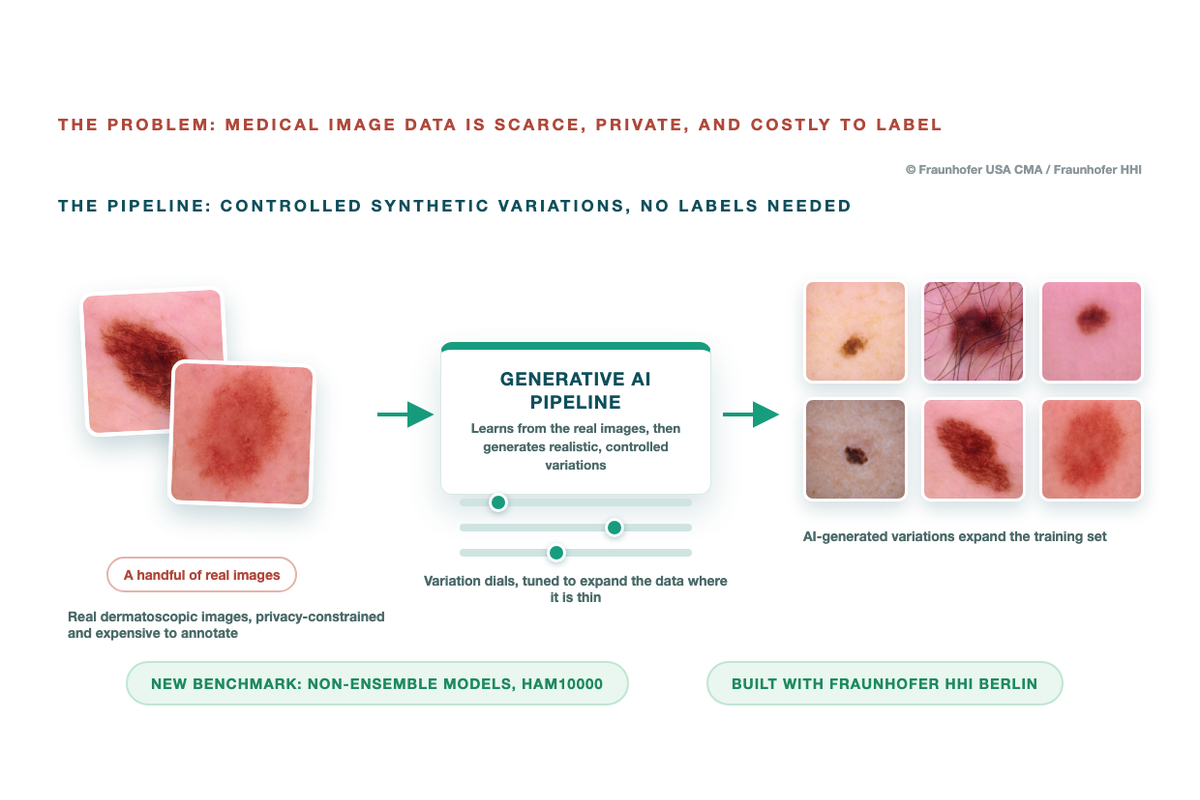
Synthetic medical images that made a real diagnostic model better. Fraunhofer USA CMA (CMA) and the Fraunhofer Heinrich Hertz Institute in Berlin built a pipeline that generates dermatoscopic skin lesion images, and models trained on that data set a new benchmark among non-ensemble models for skin lesion classification on HAM10000, a standard public dermatology dataset.
Diagnostic AI for dermatology is starved for training data. Medical images are hard to collect because of privacy rules and regulatory constraints, expert annotation is expensive, and the variations that matter clinically are exactly the ones underrepresented in the datasets that exist.
CMA co-developed a generative AI pipeline that works without labeled data. The pipeline learns from real dermatoscopic images and produces realistic, controlled variations of them, each one a change a clinician would recognize. That lets it expand a dataset exactly where it is thin, without collecting a single new patient image.
Models trained on the augmented data reached state-of-the-art accuracy for non-ensemble skin lesion classifiers on HAM10000, and the discovered directions doubled as an explainability tool for studying what the models respond to. The same partnership also develops AR-assisted surgical
 Fraunhofer USA Center Mid-Atlantic CMA