 Fraunhofer USA Center Mid-Atlantic CMA
Closed-Loop Process Control for Laser Welding
Real-Time Parameter Optimization
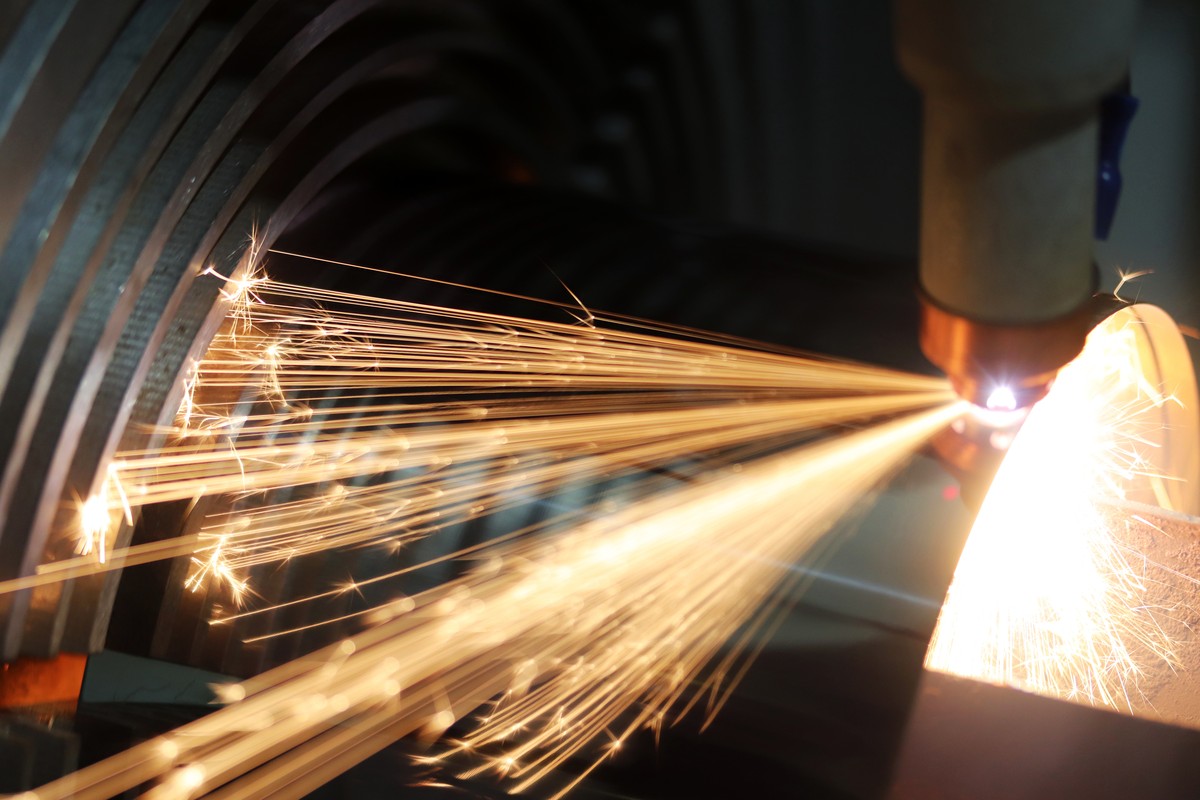
Predicting hidden weld quality and correcting the process in 10 to 25 milliseconds.
The Challenge
Laser welding is a highly dynamic process where small changes in process conditions can lead to defects such as porosity, lack of fusion, excessive penetration, blowouts, and melt overflow.
A particular challenge is that critical quality characteristics such as weld depth and bonding width are hidden beneath the weld surface and cannot be directly assessed during welding. Traditionally, these measures require post-process inspection, making it difficult to identify and respond to quality deviations while the weld is still being formed.
Our Approach
Fraunhofer USA CMA developed a multimodal, AI-based closed-loop system that combines real-time quality monitoring with adaptive process optimization.
A high-speed camera and high-speed laser microphone capture complementary optical and acoustic process signals. AI models fuse these data streams to predict four critical quality measures in real time: blowout, melt overflow, weld depth, and bonding width.
These predictions feed an AI-based controller that detects deviations from target quality and uses surrogate models and optimization algorithms to determine adjustments to up to seven process parameters, including beam oscillation and laser power modulation.
Read our full publication on AI-based closed-loop process control for laser welding
The Impact
The system achieved more than 90% weld-level classification accuracy for the evaluated subsurface quality measures. The monitoring and optimization functions operate with a computational cycle of approximately 3 milliseconds, enabling an end-to-end reaction time of approximately 10 to 25 milliseconds.
In stochastic process simulations, the closed-loop approach reduced deviation from target quality values by 29 to 48%, depending on the quality measure.
Together, these results demonstrate the potential to move laser welding from a process that reports quality after the fact to one that can respond to quality deviations while the weld is still being formed, enabling faster, more consistent, and adaptive process control.