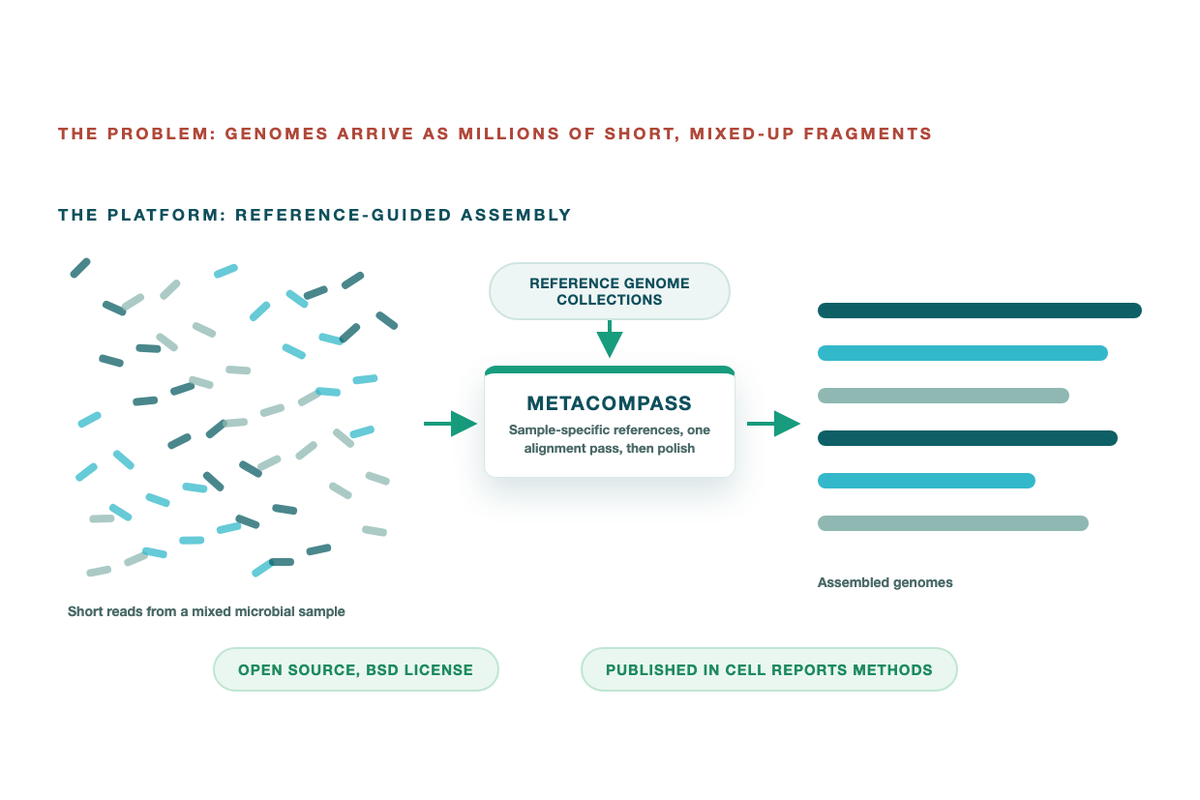
etaCompass is an open-source platform for reference-guided assembly of metagenomes, developed with the University of Maryland’s Center for Bioinformatics and Computational Biology and published in Cell Reports Methods.
Most microbes cannot be grown in a laboratory, so researchers study them by sequencing DNA straight from a sample, such as a microbiome swab or an environmental sample. What comes back is millions of short fragments from many organisms mixed together, and reconstructing genomes from that mixture is a hard computational problem. Assemblers that start from scratch struggle with it, even though hundreds of thousands of already-sequenced reference genomes exist that could guide the reconstruction.
MetaCompass puts those references to work. It builds a reference collection specific to each sample, aligns the reads against it in a single pass, and polishes the result to resolve the differences between the sample and the references. CMA worked on the platform alongside the university team: we co-developed the algorithm, implemented the system, and built the test suite that made it solid enough to release publicly.
Evaluated on 90 samples from the Human Microbiome Project, MetaCompass produced assemblies that generally outperform de novo assemblies of the same data, without significant computational overhead. The work ended in a peer-reviewed publication in Cell Reports Methods, and the software is released as open source under a BSD license for any lab to use.
 Fraunhofer USA Center Mid-Atlantic CMA